45 years of the Volkswagen LT commercial van
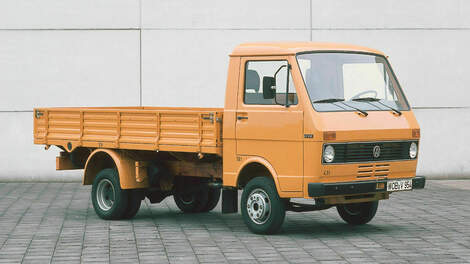
Good old Bulli was born 70 years ago. A quarter of a century later, a new “brother” appeared in the VW family, designed primarily for the transport of goods with the abbreviated name LT. The car was presented in Berlin exactly 45 years ago. Since the Bulli was not designed for very heavy loads, VW developed this model to complement its range of trucks in the 2.8 to 3.5 ton segment.
The LT cargo conveyor received digital additions to its name - the designations 28, 30 and 35, indicating the permissible total mass of 2.8,3.0 and 3.5 tons. As with the Bulli van, for the LT, Volkswagen listened to customer requests, which is why the LT is available from the outset with two wheelbases and two roof options, and the vehicle options are van, bus, platform, double cab, and chassis cab.
During development, first of all, they were looking for a better and more comfortable area than a rear-engined minibus. To this end, Volkswagen engineers are designing a vehicle with compact space and a front engine positioned between the driver and front passenger seat above the front axle. The drive is left on the rear axle. Without a rear engine, the entire cargo area is larger and more usable.
Volkswagen was also proud of the LT's ergonomics, which until then had been neglected in commercial vehicles. The cockpit has been designed with the help of experts in the field and, for example, thanks to this collaboration, the controls are located close to the driver, along with a large front window and very large exterior mirrors.
The advanced axle independent suspension system, which was not yet standard in the segment at the time, provided additional driving comfort with the introduction of the LT.
Initially, the model is available with a 2.0-liter four-cylinder gasoline engine from the Audi 100 with 75 hp. or with a 2.7-liter four-cylinder diesel engine from the English manufacturer Perkins with 65 hp.
Volkswagen replaced it in 1979 with the first six-cylinder diesel engine. The new LT 2.4-litre diesel engine produced just 8 hp. more power than its predecessor, but with significantly more torque and extremely smooth operation - so quiet that Volvo even installed this engine in the brand's first six-cylinder car.
After 21 years, the era of compact and popular cargo carriers ended in 1996. The transition from LT1 to LT2 was a transition to a more modern era. The LT2 is a premium vehicle produced by Volkswagen Commercial Vehicles (VWN), founded in 1995 and based in Hannover. This research series has been developed in collaboration with Mercedes-Benz.
Building on the concept, its predecessor introduced the Crafter in 2006. Visually and technically, this is a completely new car, as can be seen from the name change. In ten years of production, Crafter has produced a wide range of options - van, bus, platform, double cab and chassis. More than 480,000 units sold speak of the success of the third generation.
In 2016, Volkswagen Commercial Vehicles first introduced the second generation Crafter. Until the end of 2019 new Crafter has already produced nearly 260,000 units.